
Bank funding reconfiguration in the new rate cycle
As ECB liquidity recedes, deposits and debt issuance are once again the backbone of bank funding in Europe. Spanish banks start from a stronger deposit base, but rising competition for savings and costlier wholesale markets are eroding that cushion.
Abstract: European banks have shifted from heavy reliance on TLTROs to a funding model based on customer deposits and market issuance, at a time of renewed lending growth and elevated interest rates. According to their European Banking Authority (EBA) Funding Plans, retail deposits are projected to continue expanding, while wholesale issuance, concentrated in senior preferred debt and asset-backed securities, is expected to account for a larger share of liabilities. Spanish banks have followed the same pattern, with deposits and debt issues replacing interbank funding as liabilities have grown. Their higher proportion of sight deposits (84% versus 74% in Europe) keeps aggregate funding costs below the European average. This advantage is narrower than in the previous interest rate hiking cycle, however, as the faster repricing of term deposits has largely closed the gap in rates offered. Debt issuance has also increased, rising by over 25% year on year in the first half of 2026, with a composition tilted toward costlier secured and senior non-preferred instruments. Given the reduced room for manoeuvre, liability management will be central to safeguarding profitability.
Foreword
The European banks’ funding structure has undergone deep transformation in the last five years, shaped by the successive shifts in monetary policy. Following a period marked by abundant liquidity and access to European Central Bank funding on particularly attractive terms, monetary normalisation has brought the traditional sources of funding — customer deposits and debt issues — back to the fore.
This change is particularly important against the backdrop of more dynamic lending activity and higher interest rates. In this scenario, liability management does not depend solely on the banks’ ability to attract funds but also their funding mix and the costs associated with each source of financing. Funding composition is therefore key to understanding the differences between banking systems and their ability to navigate the new market conditions.
This paper analyses how the European banks are reconfiguring their liability structures based on the strategies gleaned from the EBA Funding Plans and goes on to take a closer look at the Spanish banks’ funding structure. The aim is to pinpoint the Spanish banks’ specific attributes compared to the European system as a whole and assess how their starting position could condition their ability to tackle fresh pressure on funding costs.
Liability composition shift across the European banks
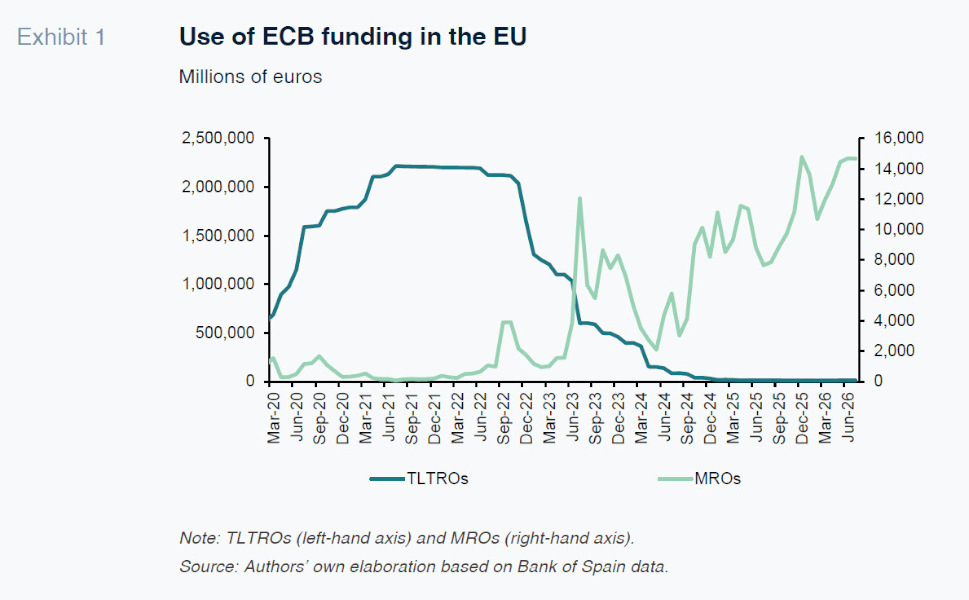
The use of the European Central Bank (ECB) as a source of finance illustrates the changes in the interest rate cycle in the last five years very clearly. As shown in Exhibit 1, during the final phase of negative rates and at the height of the pandemic, the European banks turned significantly to the ECB’s long-term financing tools, mainly articulated in the form of its Targeted Longer-Term Refinancing Operations (TLTROs), provided on very attractive terms. However, once the shift in monetary policy took place, the relative cost of holding the TLTRO funds to maturity ceased to be beneficial relative to other alternatives in an environment of abundant liquidity, accelerating their repayment down to negligible levels. Subsequently, in a climate of monetary normalisation, use of ECB funding has switched to its Main Refinancing Operations (MROs), albeit with the banks drawing down significantly lower volumes compared to the previous TLTROs.
Meanwhile, with the interbank funding channel restored, as gleaned from the information provided in Exhibit 2, other sources of funding came to the fore. In particular, deposit-taking from households and non-financial corporations (NFCs) has experienced sustained growth, cementing these liabilities’ position as the sector’s chief source of funding.
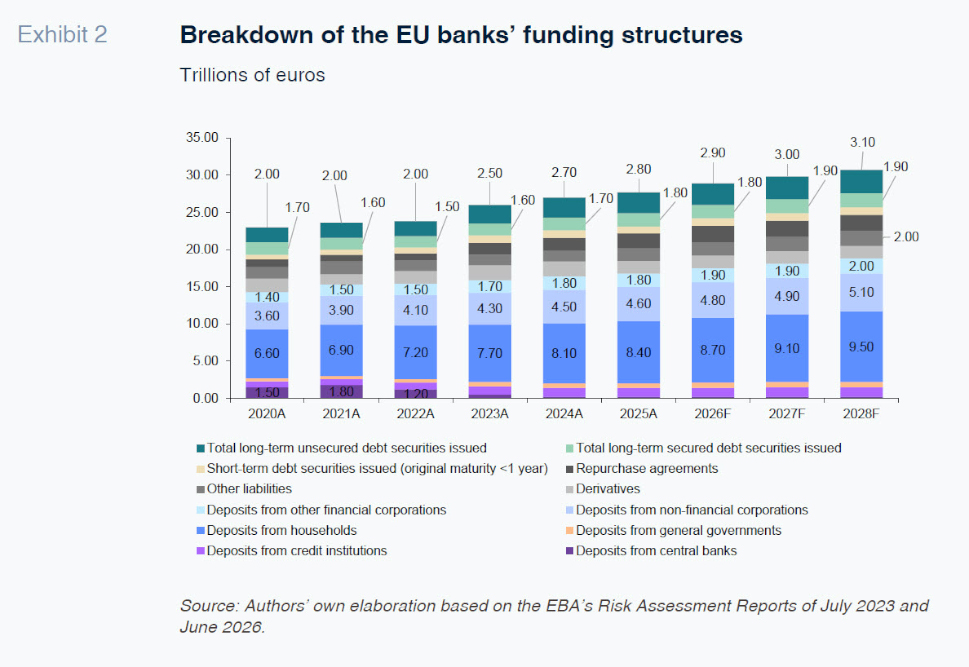
According to the banks’ Funding Plans, although wholesale market funding is expected to gain a little more space in their funding structure, retail funding is not expected to lose dynamism, as household and NFC deposits are expected to continue to post annual growth of close to 4% during the planning horizon.
Specifically, the European banks expect to step up their wholesale market issues, not only in order to refinance existing debt as it falls due but also on a net basis. The issues planned for 2026 are concentrated in senior preferred debt and asset-backed securities (ABSs). In contrast, alternatives such as non-preferred bonds and unsecured senior debt are expected to lose a little weight in the liability mix. Therefore, in an environment of rising rates, the banks are shifting their funding towards instruments with a relatively low cost in order both to refinance and to finance balance sheet growth.
These funding dynamics are accompanied by a positive outlook for growth in lending, specifically growth of over 5% in corporate lending and of around 3% or 4% in household lending in 2026. However, we think those rates may be revised lower in the wake of the spike in long-term rates observed in recent months, which is likely to put a brake on demand for credit.
Liability reconfiguration at the Spanish banks
Having analysed the European banks’ Funding Plans, we now turn our attention to the Spanish banking system, where funding patterns are following a similar trend. As shown in Exhibit 3, bank liabilities have been posting sustained growth, driven in recent years by a higher funding requirement derived from the recovery in lending activity. In parallel to this growth, the banks have been relying less on interbank funding, offset by greater use of deposits and debt issues, despite a slight slowdown in the latter in 2025.
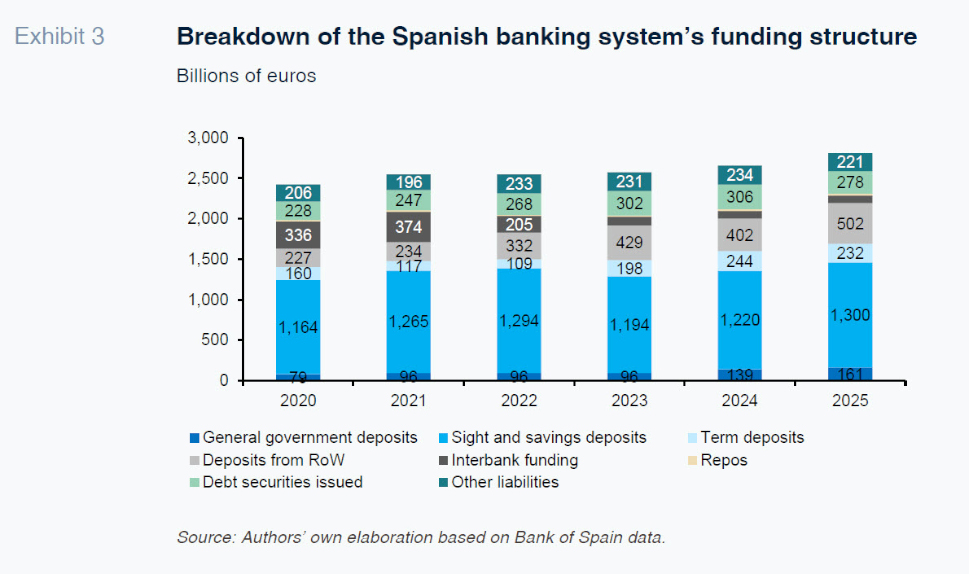
Given the significance of these two sources of funding (deposits and debt issues), we next take a closer look at the trends in each in terms of volumes, composition and associated costs.
In the case of deposits, the expansion has been underpinned by growth in both sight and term deposits, which have been trending in line with their forecasts for annual growth of 4% as per their EBA Funding Plans, with that growth even higher than expected in the business segment.
In terms of the cost of those retail deposits, in contrast to what happened during the last round of rate increases, when an abundance of liquidity allowed the Spanish banks to hold off on increasing the rates they offered their deposit-holders relative to their European counterparts, current market competitive dynamics and growth in assets have sparked a quicker increase in the rates offered for new term deposits.
As shown in Exhibits 4 and 5, the increased competition for new deposits has had the effect of bringing the rates offered in Spain closer in line with European levels, substantially reducing a gap that reached around one percentage point during the last cycle.
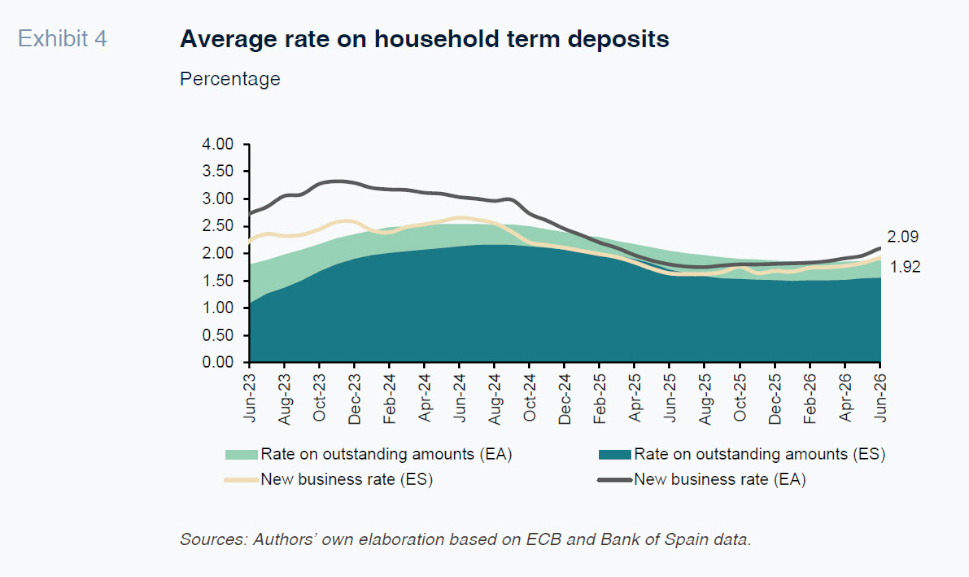
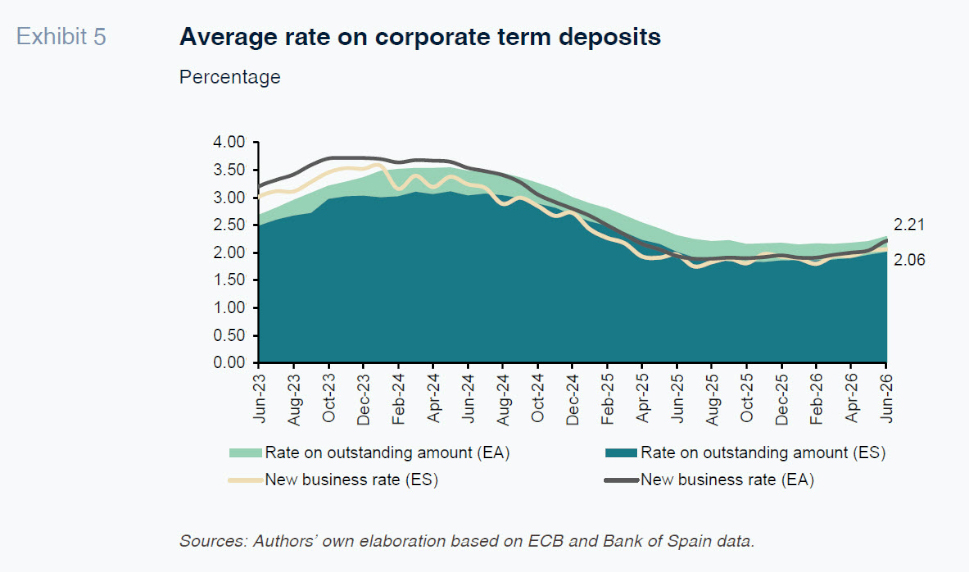
However, this convergence has not brought the overall retail funding cost fully in line with the European average because of the structurally higher share of sight deposits held by the Spanish banks relative to their European peers (84% versus 74%, respectively). This composition effect, i.e., reduced reliance on term deposits, at least until now, gives the Spanish banks an ongoing competitive advantage in aggregate deposit cost terms and translates into better positioning in net interest margin terms.
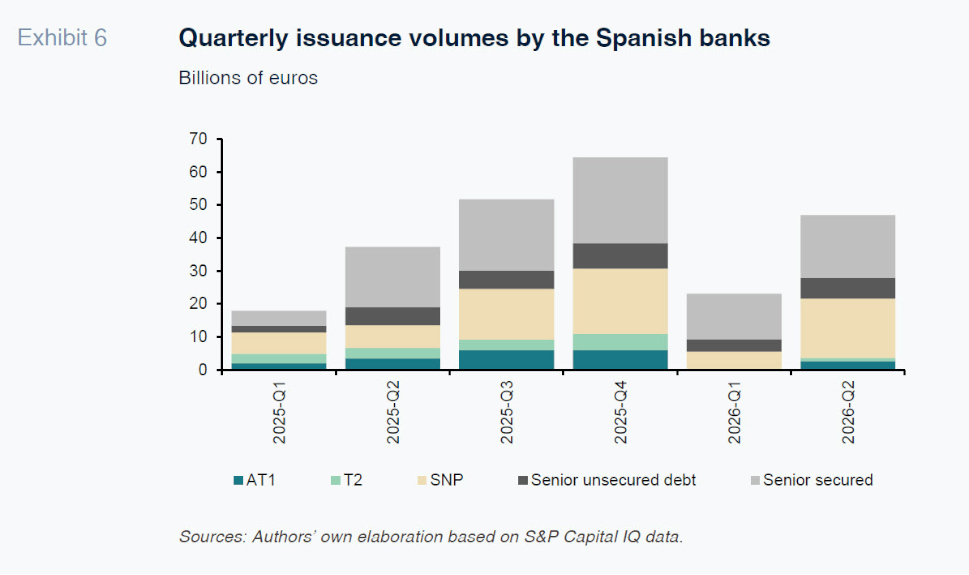
As for securities issues, during the first half of 2026, the Spanish banks were clearly more active compared to the same period of 2025 (Exhibit 6). Gross issuance volumes came to around 45 billion euros in the first quarter, year-on-year growth of over 25%. Issuance volumes have been concentrated in secured and senior non-preferred (SNP) debt, depicting a higher-cost funding mix relative to the issues contemplated by the European banks as a whole, due to the higher levels of non-preferred debt issuance in Spain.
The increase in volumes has not been accompanied by an even increase in cost across the different instruments, as is shown in Exhibit 7. Option-adjusted spreads over swaps (swap OAS) on euro-denominated bank debt have spiked on three occasions during the past 18 months. The first time, in spring 2025, associated with the fallout from the announcement of new tariffs in the U.S.; the second time, in the first quarter of 2026, triggered by the onset of the conflict in the Middle East; and the third, in early October 2026, shaped by stress in the sovereign debt markets and the pressure exerted by AI-adjacent issuance volumes.
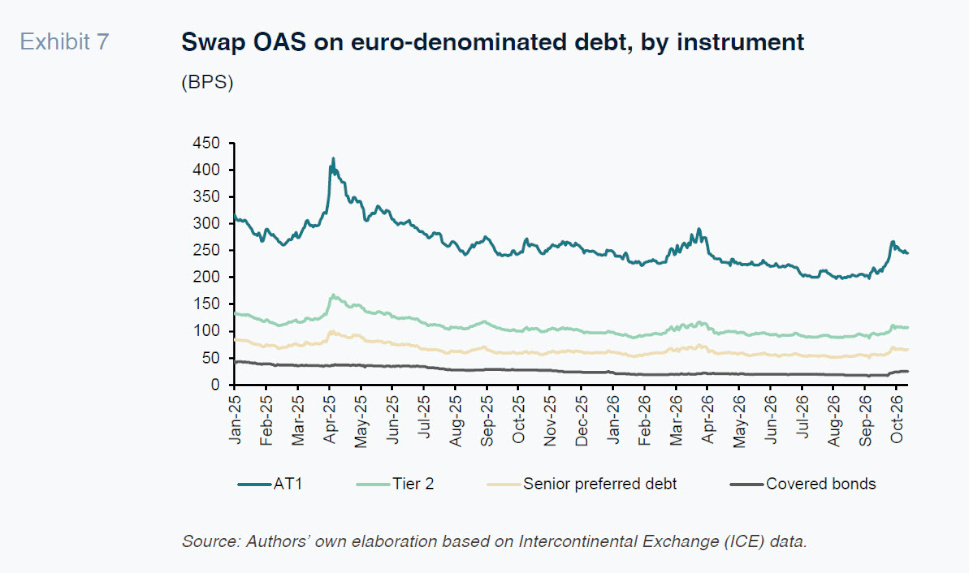
Beyond the different causes underlying each of these episodes, all three share a common pattern in terms of the impact on spreads, which have widened by less across the less subordinated instruments. Specifically, spreads on covered bonds have barely moved, whereas AT1 and Tier 2 instruments have been more sensitive, indicating that the market continues to discriminate between the specific risk characteristics of each instrument, particularly during times of greater volatility.
The uptick in volatility against the backdrop of heightened geopolitical and economic uncertainty, coupled with the prospect of higher-for-longer interest rates, could put some pressure on issue costs, particularly for more subordinated instruments. This is also tangible in the above-mentioned intensification of competition for deposits, which is materialising not only in the rising cost of attracting term deposits but also in the banks’ commercial dynamics. We are seeing the banks clearly focus their sales strategies on winning bundled customers through remunerated accounts as the key to maintaining transactional balance stability, which is crucial at a time of credit growth, rising deposit costs and intense competition.
Conclusions
The European banks’ liability reconfiguration dynamics reflect a transition towards a funding structure in which deposits and debt issues have returned to the fore following a period of extraordinary reliance on ECB liquidity. In this process, the Spanish banks have certain advantages relative to the European banks as a whole, due particularly to their higher share of sight deposits, which continues to keep their funding costs lower.
However, today’s conditions are different to those observed during the last cycle of rate increases. More dynamic lending activity, less abundant liquidity and renewed pressure on deposit costs are eating away at some of this advantage. As a result, liability mix strategy and management will prove key to propping up bank profitability in an environment of greater monetary and financial instability.
Ángel Berges, Laura Ciriza, María Rodríguez. Afi